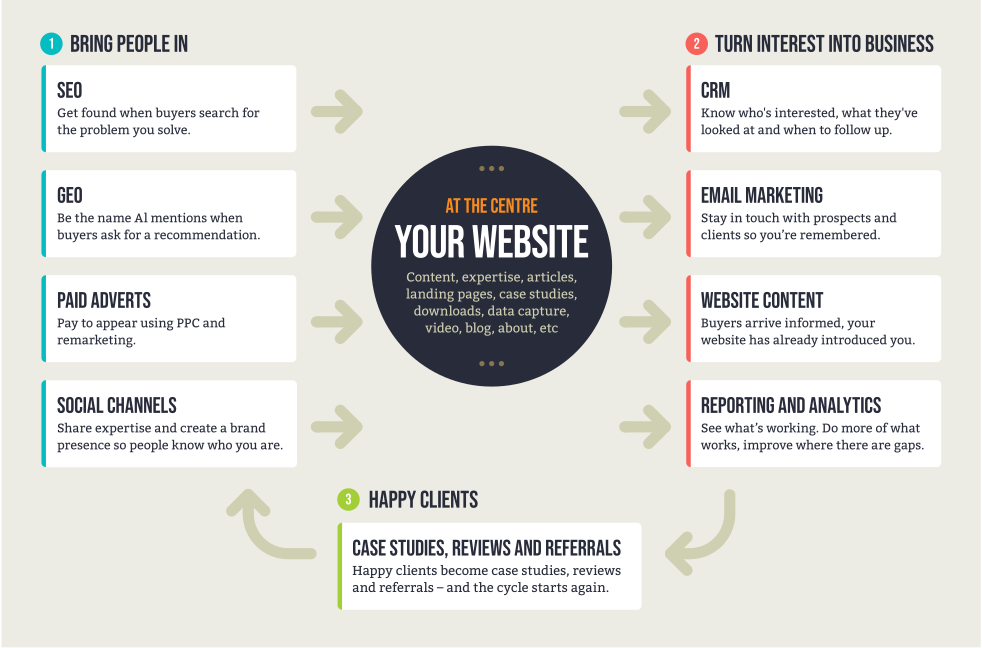
In one diagram, why your B2B website is so important.

In B2B everything leads back to your website.
How B2B marketing works, and why your website sits in the middle.
B2B marketing can feel like a long list of separate tasks. SEO, social, email, paid search, a CRM that someone set up three years ago and an analytics dashboard nobody quite trusts or understands. They have evolved over time, and probably don’t talk to each other and may not produce any meaningful results.
However they all point in one direction. Nearly every marketing channel brings people to your website.
Bringing the right people in.
On the left are the channels that get you noticed. SEO helps you get found when someone searches for the problem you solve. GEO is the newer one, and it’s about making sure AI tools like ChatGPT mention you when a buyer asks for a recommendation. PPC lets you pay to appear for the searches that matter most. Social and content are where you show what you know, so people have heard of you before they need you.
Turning interest into business.
On the right is what happens next. CRM tells you who’s interested and what they’ve looked at. Email keeps you useful between purchases, so you’re remembered when the time comes. Analytics shows you what’s working, so you can put more effort into what's working, and make changes where there are gaps.
There’s also the sales conversation. By the time a buyer picks up the phone or completes an enquiry form, they’ve usually read your website, compared you with others and talked it through with colleagues. Your website has already introduced you.
Why this matters more than it used to.
Research on how B2B buyers behave has become hard to ignore. 6sense’s study of more than 4,600 buyers found that buyers choose the supplier they already favoured before speaking to sales 82% of the time. If you don’t make their first shortlist, your chance of winning drops below 10%.
Forrester’s research adds that a typical purchase is influenced by 13 people inside the business and nine outside it. They won’t all take a sales call, but most of them will look at your website. It’s also worth knowing that 94% of B2B buyers now use generative AI somewhere in their buying process, so your website needs to make sense to AI tools as well as to people.
Keeping the cycle going.
The last part of the picture is the loop at the bottom. Happy clients become case studies, reviews and referrals, which go back on your website and help bring in the next group of buyers. When it’s working well, each piece of marketing makes the next one easier.
If your channels feel disconnected, or your website isn’t doing as much as it should, we’d be happy to talk it through.